
Fishermen and the fishing industry make up a large part of Jeffreys Bay’s early history. Long before it became a holiday town or world-famous surf destination. JBay’s main beachfront boasts two heritage sites linked to the fishing industry of old.
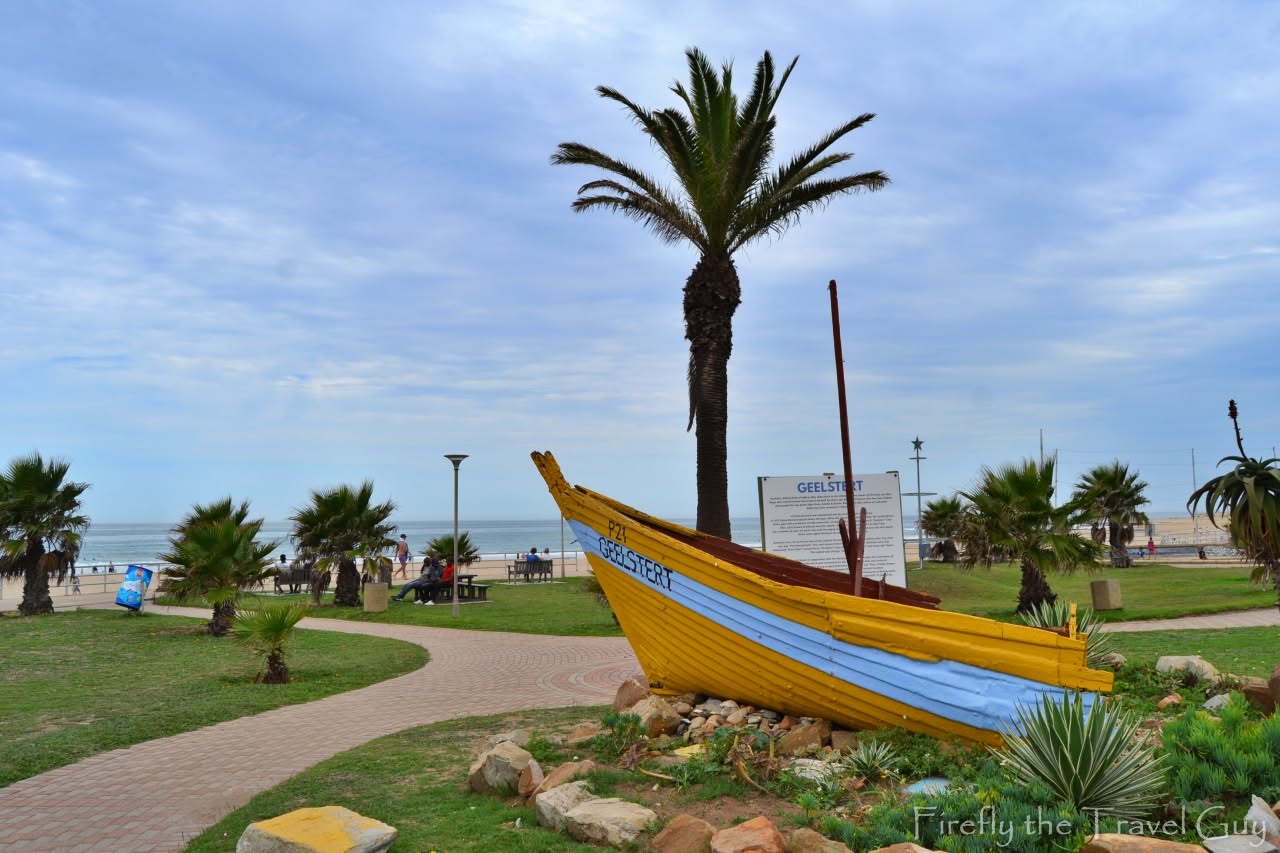
Standing proudly near the shoreline in front of the building housing the famous Jbay Shell Museum are the remains of a yellow fishing boat. The Geelstert is more than just a weathered fishing boat—it’s a symbol of the town’s rich fishing heritage.
Dating back to the 1960s, Geelstert was originally built in Knysna and formed part of a small but hardworking fishing fleet that once operated along this stretch of coastline. Over the years, the boat changed hands, was renamed, restored, and even abandoned more than once—yet its story never faded.

Painted bright yellow and given the name “Geelstert,” the boat became a familiar sight in Jeffreys Bay, with local fishermen and captains leaving their mark on its history. Along with “Poormansfriend”, Geelstert was one of the last two of the original 20 working fishing boats in Jeffreys Bay.
In the late 1990s, a passionate group of locals came together to preserve this piece of history. Their efforts saw the boat retrieved from where it was abandoned amongst the dunes, restored and moved to its current position, where it now serves as a tribute to the generations of fishermen who once worked these waters.

Not far from Geelstert, you will find a statue of a dog. Simonstown has the statue of Just Nuisance and there is one of Jock of the Bushveld in Barberton, but this dog called Brag is a very special one, and this is his story.

During the 1940’s, when Jeffreys Bay was still mainly a fishing village, Charles October Hammond served as the captain of the rowing boat “Poor man’s friend”. Hammond had a dog named Brag who was his best friend. Every day when Hammond and his crew of eight took to the waves to do the day’s fishing, Brag was seen on the beach with them. He would run up and down the beach watching their progress until they were out of sight. Brag would then position himself at the high-water mark, resting his head on his paws, whilst keeping a watchful eye on the horizon in anticipation of their return.
He would maintain this position until sighting them on their return, usually at about 14:00. Brag would again be running up and down the beach, barking and howling excitedly, with nothing or nobody able to draw his attention away from the crew returning home. One day, however, during inclement weather, the crew got caught in a strong current and had to row very hard to reach the shore. A huge wave capsized the boat, and the captain and his crew were tossed into the stormy sea. They were fortunate as they all made to shore alive.

Upon sighting the disaster unfolding, Brag, without hesitation, rushed into the water, confident of going to rescue his master. Regrettably, the same current that caught them off-guard gripped the brave Brag and ripped him out to sea. Captain Hammond had to watch as his beloved friend Brag was pulled under, never to be seen again.

The statue was put up in 2022 and is another of the projects spearheaded by Jeffreysbaai Dorp van Drome in conjunction with Jeffreys Bay Tourism and the Kouga Municipality.
Both these heritage sites are just more proof that you don’t have to spend millions and put up huge statues or monuments to create new heritage sites. I think, even more importantly, it shows that not all heritage sites need to be political; you can also celebrate the lesser-known history, or just a symbol of bravery, loyalty, and unwavering devotion.