

Port Elizabeth has several well-known war memorials commemorating the lives lost during the two World Wars. The Cenotaph at St George’s Park and the Walmer War Memorial are probably the two main ones. One that very few people know about is the war memorial located on the Walmer Golf Course.
When the township of Walmer was laid out in 1852, it was surrounded by a “green belt” referred to as the commonage. It was on this commonage, where the locals were entitled to graze their animals, that the Walmer Golf Course was first laid out in 1897 and the Walmer Golf Club formed.
Not only did the First World War impact the club through the loss of a number of members, but it also led to the loss of 9 holes. Each of the course’s 18 holes was supported and maintained by a different family. War deaths in the families and tough times after the war led to several families withdrawing and it was decided to reduce the course to 9 holes.
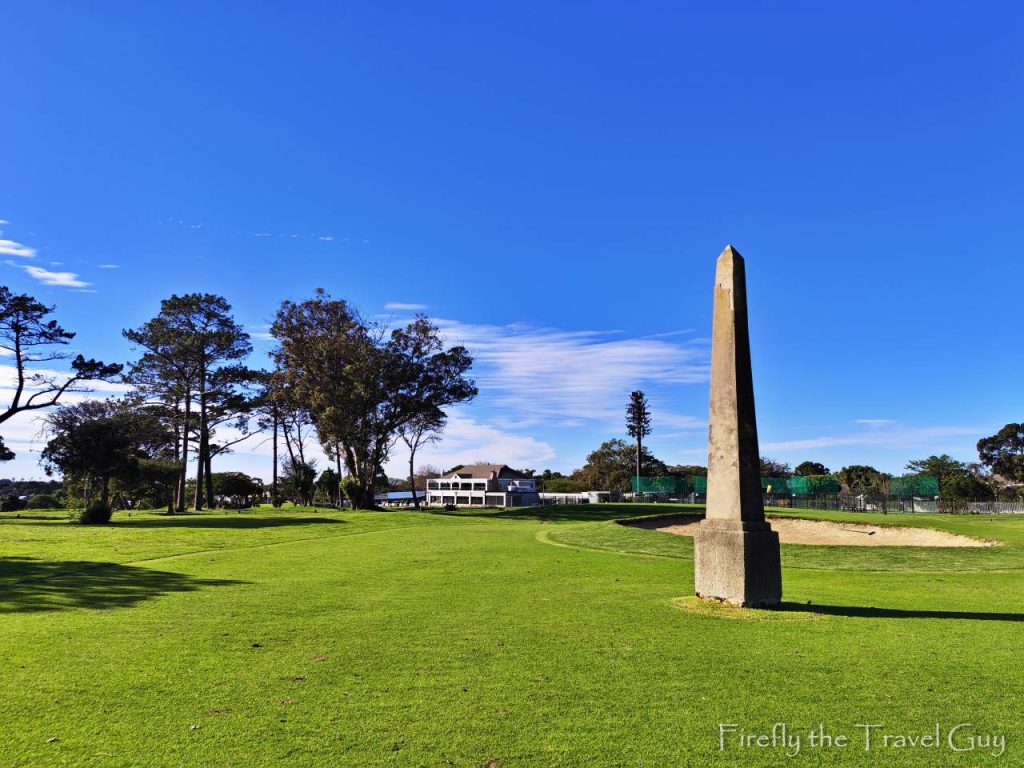
Even before the armistice ending the First World War was signed on 11 November 1918, the locals formed a peace celebrations committee which was responsible for the construction of the obelisk and the brushwood fortress that surrounded it. The fortress measured 106 feet in diameter and the brushwood was stacked up to 12 feet in height. In the centre, reaching 27 feet total height was a brushwood effigy of a German soldier holding a sword in one hand and a torch in the other. On either side was a brushwood long-range gun and behind was a large howitzer. The whole complex was the brainchild of William John McWilliams. The peace treaty was finally signed and on the evening of Saturday, 19 July 1919, a crowd gathered around the brushwood fortress. The Mayor of Walmer, John Syme Neave, addressed the crowd and the fortress was set alight.
The only writing on the obelisk is the word PAX (the Latin noun for “peace”) and the year the war ended: 1918.